Long Live Little Brats
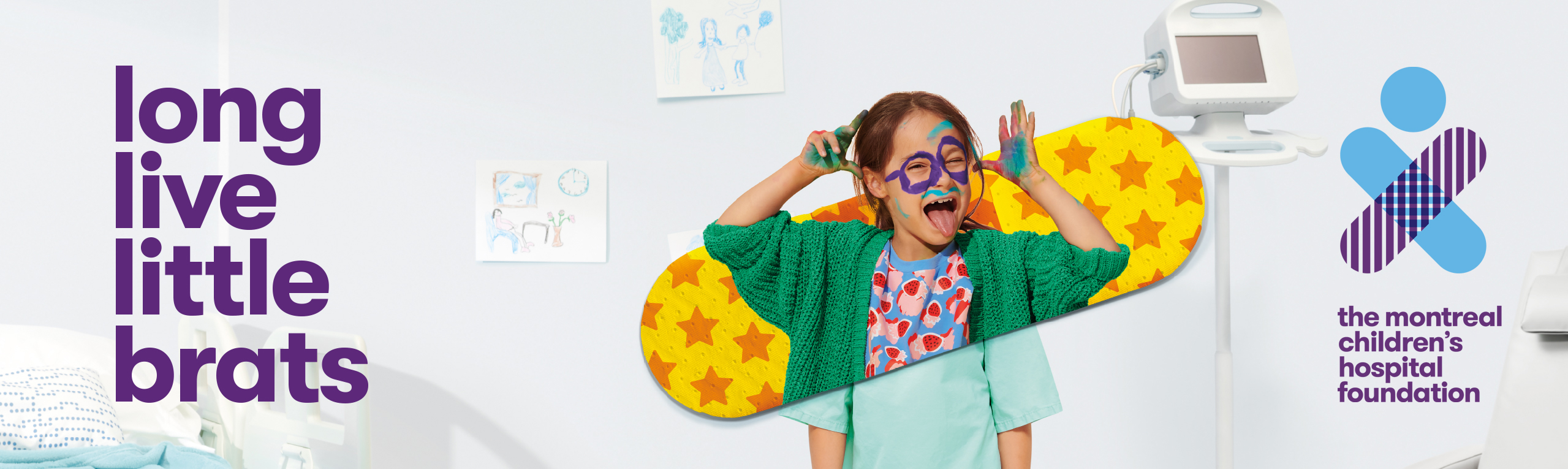
They are sometimes unruly. Rambunctious. Loud. Strong willed. Who cares? At The Children’s, we prefer our kids to be spirited, even a little bratty – anything but sick.
Because a bratty kid is a healthy kid, we invite you to celebrate the mischievous side of children in Quebec. Help The Children’s get its young patients back on their feet and bursting with energy again.
Long live our little brats!
Thanks to contributions from our invaluable partners, sponsors and major donors, we can launch these innovative projects. To implement them, we have the best minds in the world and the solid reputation of McGill University’s Faculty of Medicine, the best in Canada.
Innovation is the key to progress, and The Children’s is uniquely positioned to make new breakthroughs, set new standards and move mountains.
PROJECTS
THE HEALING ART PROJECT
For 40% of The Children’s patients, the Hospital is almost a second home. Average hospital stays are 8 days and some kids are hospitalized for months. Dedicated staff, highly trained professionals and state of the art equipment aren’t enough to make the Hospital a child-friendly environment.
We will create partnerships with Montreal’s cutting-edge multimedia agencies and Quebec’s artistic talent to fill The Children’s with
purposeful healing art, which has been proven to speed healing by reducing children and teens’ anxiety, stress and perception of pain.
SMART HOSPITAL
Hospitalized children’s vital signs are monitored manually or by machines, which takes more manpower, limits their ability to move and prevents their parents from holding them. Babies in the Neonatal Intensive Care Unit are a prime example.
We will put children back in their parents’ arms, where they belong, with a pilot project to develop wireless vital signs monitoring. It will be a first for children in Canada and will serve as a model for other pediatric hospitals.
COMPLEX CARE CENTRE
40% of patients at The Children’s are seen by an average of 16 physicians from at least 6 different specialties. Their complicated needs are difficult for parents to manage and are poorly understood by community healthcare providers, causing added stress for parents.
We will create Canada’s first complex care centre to deliver personalized, comprehensive and coordinated care at the Hospital, in the community and at home. Our evidence-based best practices and programs will serve as a template for others.
PEDIATRIC CENTRE FOR APPLIED NANOMEDICINE
Liquid biopsy cancer project: Solid tumours represent 30% of pediatric cancer tumours. Children must undergo multiple painful bone marrow and tumour biopsies to ensure their treatments have been successful. In the case of brain tumours, this is not always possible.
In this pilot project, we will eliminate painful bone and tissue biopsies, and give new hope to children with brain tumours. We are developing simple blood tests to detect the exosome fingerprint to identify and monitor cancerous tumours. These discoveries will serve as a model for other
diseases and pediatric hospitals throughout the world.
PEDATRIC CENTRE FOR APPLIED GENETICS
Universal genetic screening for kids with cancer: Up to 10% of all children with cancer have a genetic risk of developing one or more cancers later in life. Many immune system disorders can also cause aggressive cancers.
We will create the first clinic in Canada dedicated to discovering the genetic links that predispose children to cancer. We will screen all young
cancer patients, using artificial intelligence and our unique research platforms to identify risk factors for secondary cancers and remove this stressful burden from children and their families.
APPLIED BIOLOGICAL THERAPIES CENTRE OF EXCELLENCE
Biological therapies are the fastest growing treatment for children with autoimmune diseases and will be the treatment of choice for almost 50% of them in 5 years. However, not all children respond identically, and little is known about the long-term effects on kids.
We will discover and improve personalized therapies with fewer side effects, starting with a real-time study of 350 patients in year 1, and adding 50 to 100 more each subsequent year.
100% FUNDED PROJECTS
CENTRE FOR COMPLEX PAIN – Donation from the Louise and Alan Edwards Foundation
Thanks to innovation breakthroughs in pain management, over the next five years hospital stays for children who are living with complex pain can be reduced, visits to the Emergency Department can be decreased and fewer patients will need to use opioids.
MINNIE’S HOPE – Donations from BMO and The Hewitt Foundation
At-risk Cree and Inuit children living in Kuujjuarapik and Whapmagoostui can receive culturally sensitive services in their community at the Minnie’s Hope Centre.